18 |

|
|
Little FriarbirdAlternate name(s): "Little Leatherhead", "Yellow-throated Friarbird" Size: 25-30 cm Body mass: 50-80 g |
 |
Similar |


|
 Description
 Classification
 Distribution
 Sightings
 Photos
 Breeding
 Nest
Nest
 Eggs
Eggs
 Behaviour
 Food
Food
 Call/s
|
|
 Click here for a physical description Click here for a physical description
|
|
||||||
|
Click here for information on habitat
and range
|
Click here for sighting information
|


|
|
Photos |
Race "citreogularis"
 |
ADULT |
Sex unknown |

Close-up frontal portrait of a Little Friarbird
[Eulah Creek, NSW, September 2025]

Frontal view of a Little Friarbird
[Eulah Creek, NSW, January 2023]

Close-up frontal portrait of a Little Friarbird looking sideways
[Eulah Creek, NSW, September 2025]
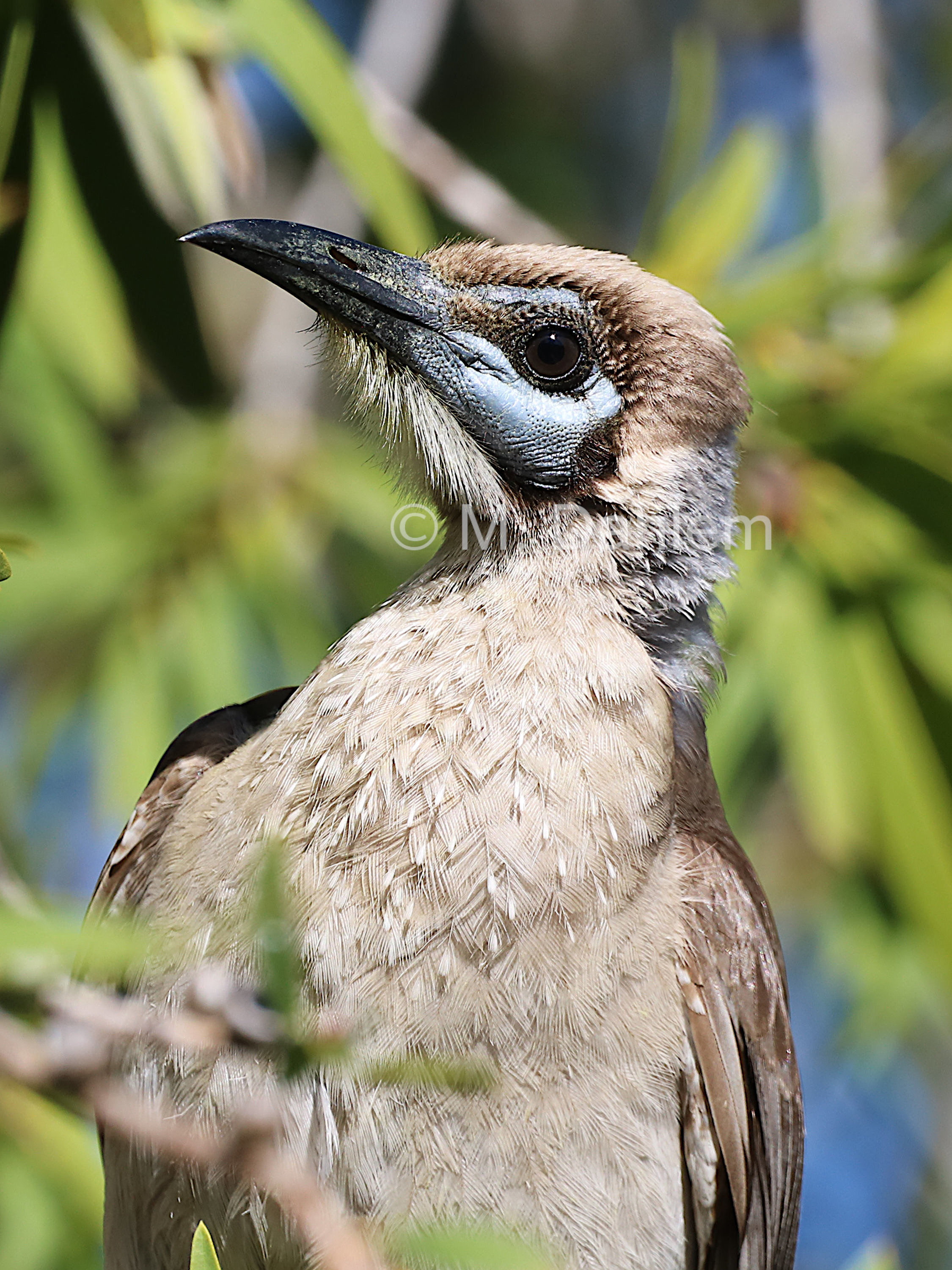
Close-up frontal portrait of a Little Friarbird looking sideways
[Eulah Creek, NSW, September 2025]

Close-up frontal/ventral view of a Little Friarbird
[Eulah Creek, NSW, October 2015]

Near-lateral view of a Little Friarbird looking sideways
[Eulah Creek, NSW, October 2020]

Near-lateral view of a Little Friarbird
[Eulah Creek, NSW, October 2020]

Close-up lateral portrait of a Little Friarbird
[Eulah Creek, NSW, November 2025]
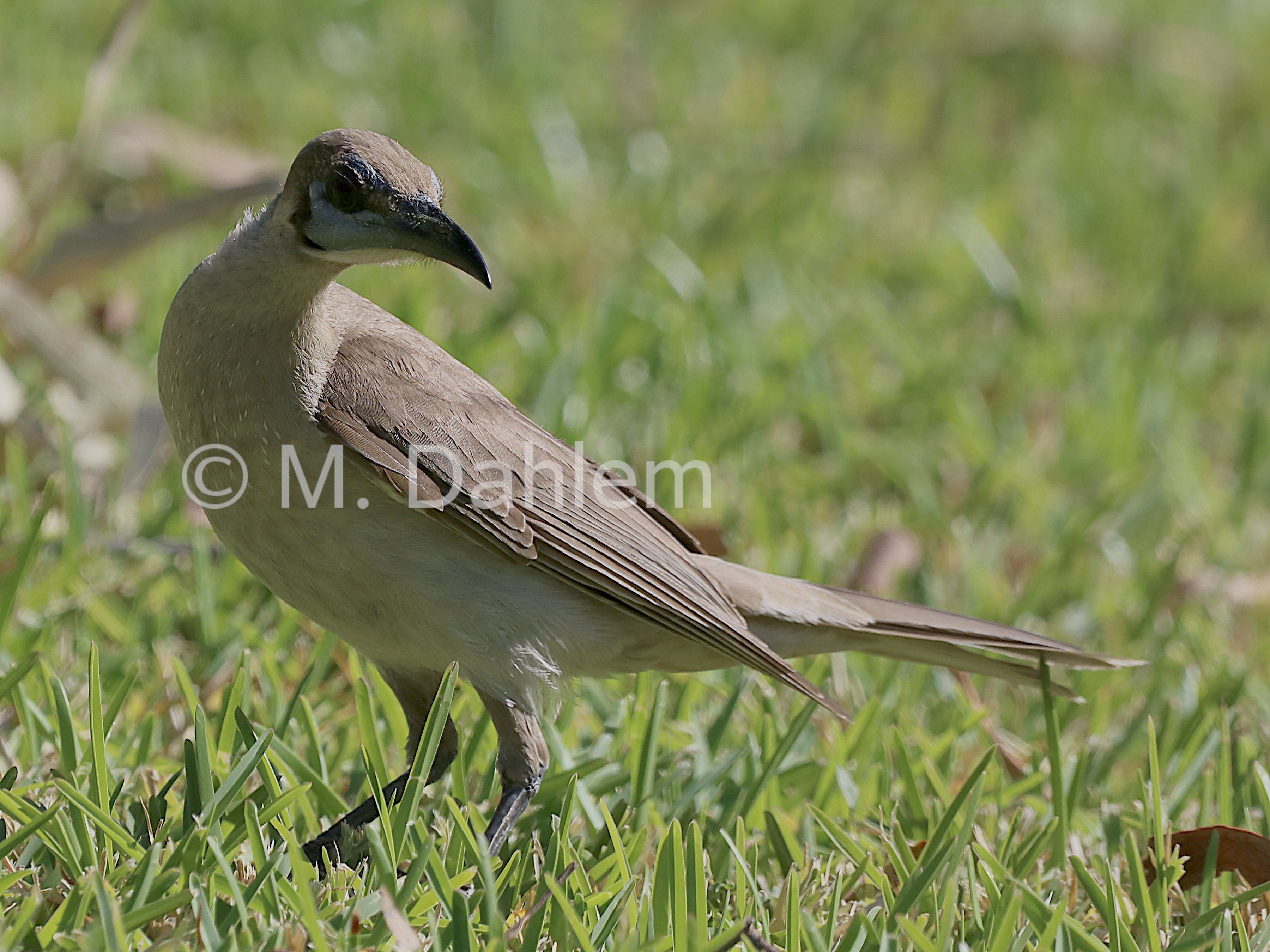
Close-up lateral view of a Little Friarbird looking towards the observer
[Eulah Creek, NSW, November 2025]

Lateral view of a Little Friarbird
(photo courtesy of M. Eaton)
[Botanical Gardens, Mackay, QLD, July 2021]

Lateral view of a Little Friarbird
[Eulah Creek, NSW, September 2007]

Lateral view of a Little Friarbird; this bird was found in a
transition zone between races "citreogularis" and "sordidus"
(photo courtesy of M. Mearns)
[Croydon, QLD, September 2019]

Lateral view of a Little Friarbird drying its
plumage after a bath
[Eulah Creek, NSW, May 2012]

Lateral view of a Little Friarbird
[Eulah Creek, NSW, December 2010]

Lateral/ventral view of a Little Friarbird sitting next to an
Olive-backed Oriole,
both waiting their turn for a drink of water under the tree
[Eulah Creek, NSW, December 2006]

Lateral view of a Little Friarbird taking off from its perch
[Yarrie Lake, near Wee Waa, NSW, January 2013]
 |
IMMATURE/JUVENILE |

Frontal view of a juvenile Little Friarbird looking
sideways and showing the typical (name-giving) yellow throat
[Near Narrabri, NSW, August 2022]

Close-up frontal view of a juvenile Little Friarbird
looking sideways
[Eulah Creek, NSW, May 2012]

Near-frontal view of a juvenile Little Friarbird begging
to be fed; note that the nectar-rich flowers all around
the bird are no good to it - it is still on a diet of
insects, not nectar
[Eulah Creek, NSW, October 2008]

Lateral view of a juvenile Little Friarbird
[Eulah Creek, NSW, May 2012]

Near-dorsal view of a juvenile Little Friarbird
(photo courtesy of M. Eaton)
[Jardine River, Cape York peninsula, QLD, August 2019]

Near-dorsal/ventral view of a juvenile Little Friarbird
(photo courtesy of M. Eaton)
[Dundowran Beach, Hervey Bay, QLD, May 2018]

Dorsal view of a juvenile Little Friarbird looking
back at the observer, showing clearly its yellow
throat
(photo courtesy of C. Linfoot)
[Harvey Range, near Townsville, QLD, April 2022]

Ventral view of a juvenile Little Friarbird waiting to be fed
[Near Narrabri, NSW, January 2006]

Ventral view of a juvenile Little Friarbird in flight
[Eulah Creek, NSW, June 2023]

Close-up frontal/ventral view of a fledgling Little Friarbird
looking sideways - number one out of a clutch of three
[Eulah Creek, NSW, November 2011]

Close-up frontal/ventral view of two fledgling Little Friarbirds
- numbers 2 and 3 out of 3
[Eulah Creek, NSW, November 2011]
Race "sordidus"
Note that the facial skin of Little Friarbirds, race "sordidus", shows less pale-blue than in the nominate race.
|
|
ADULT |
Sex unknown |

Frontal view of a Little Friarbird looking sideways
[Darwin, NT, August 2014]

Close-up near-frontal view of a Little Friarbird
(photo courtesy of P. Brown)
[Nightcliff, Darwin, NT, November 2020]

Near-frontal/ventral view of a Little Friarbird
(photo courtesy of B. Hensen)
[Darwin, NT, June 2014]

Near-lateral view of a Little Friarbird feeding in
mangrove
(photo courtesy of P. Brown)
[Darwin, NT, December 2017]

Lateral view of a Little Friarbird
(photo courtesy of B. Hensen)
[Darwin, NT, March 2013]

Lateral view of a Little Friarbird
(photo courtesy of B. Hensen)
[Darwin, NT, January 2016]

Lateral view of a Little Friarbird
(photo courtesy of P. Brown)
[McMinns Lagoon, near Darwin, NT, January 2019]

Lateral view of a Little Friarbird
(photo courtesy of P. Brown)
[Darwin, NT, May 2018]

Lateral view onto the upperparts of a Little Friarbird
(photo courtesy of B. Hensen)
[Darwin, NT, January 2016]
Lateral view of a Little Friarbird; this bird was found in a
transition zone between races "citreogularis" and "sordidus"
(photo courtesy of M. Mearns)
[Croydon, QLD, September 2019]

Ventral view of a Little Friarbird that has caught a cicada
(photo courtesy of P. Brown)
[Darwin, NT, November 2017]
|
|
IMMATURE/JUVENILE |

Lateral view of a juvenile Little Friarbird - note the yellow
chin and shoulders (photo courtesy of P. Brown)
[Holmes Jungle
Nature Park, Darwin, NT, April 2020]

Two juvenile Little Friarbirds sharing a bath
(photo courtesy of P. Brown)
[Holmes Jungle
Nature Park, Darwin, NT, April 2020]

This juvenile Little Friarbird shows copious amounts of yellow
not only on chin and cheeks, but also the characteristic yellow
edge lining on the flight feathers (photo courtesy of P. Brown)
[Darwin, NT, January 2018]

Partly obscured near-frontal view of a juvenile Little Friarbird;
note the yellow hues not only on the chin and chest, but also down
the belly to the undertail coverts (photo courtesy of P. Brown)
[Marlow's Lagoon, Palmerston, NT, December 2017]

Lateral view of a juvenile Little Friarbird;
note the yellow hues not only on the chin and chest, but also down
the belly to the undertail coverts (photo courtesy of P. Brown)
[Marlow's Lagoon, Palmerston, NT, December 2017]

Dorsal view of a juvenile Little Friarbird (photo courtesy of P. Brown)
[Marlow's Lagoon, Palmerston, NT, December 2017]
|
|
Breeding information |
| Breeding season: Jul - Feb | Eggs: 2 - 3 | Incubation period: 16 days | Fledging age: 17 - 19 days |
Given the right conditions, Little Friarbirds can breed almost any time of the year (except April/May).

While, to the best of our knowledge, ALL other local birds lost their
nests and/or broods in a severe hail storm with destructive winds in
November 2016, only the local pair of Little Friarbirds managed to
successfully raise their chicks
[Eulah Creek, NSW, December 2016]
|
|
Nest |
"bungobittah", "lar", "malunna", "jindi" [bundjalung] = nest [Aboriginal] |
| Type: Suspended basket | Material: Twigs, grass | Height above ground: 3 - 20 m |
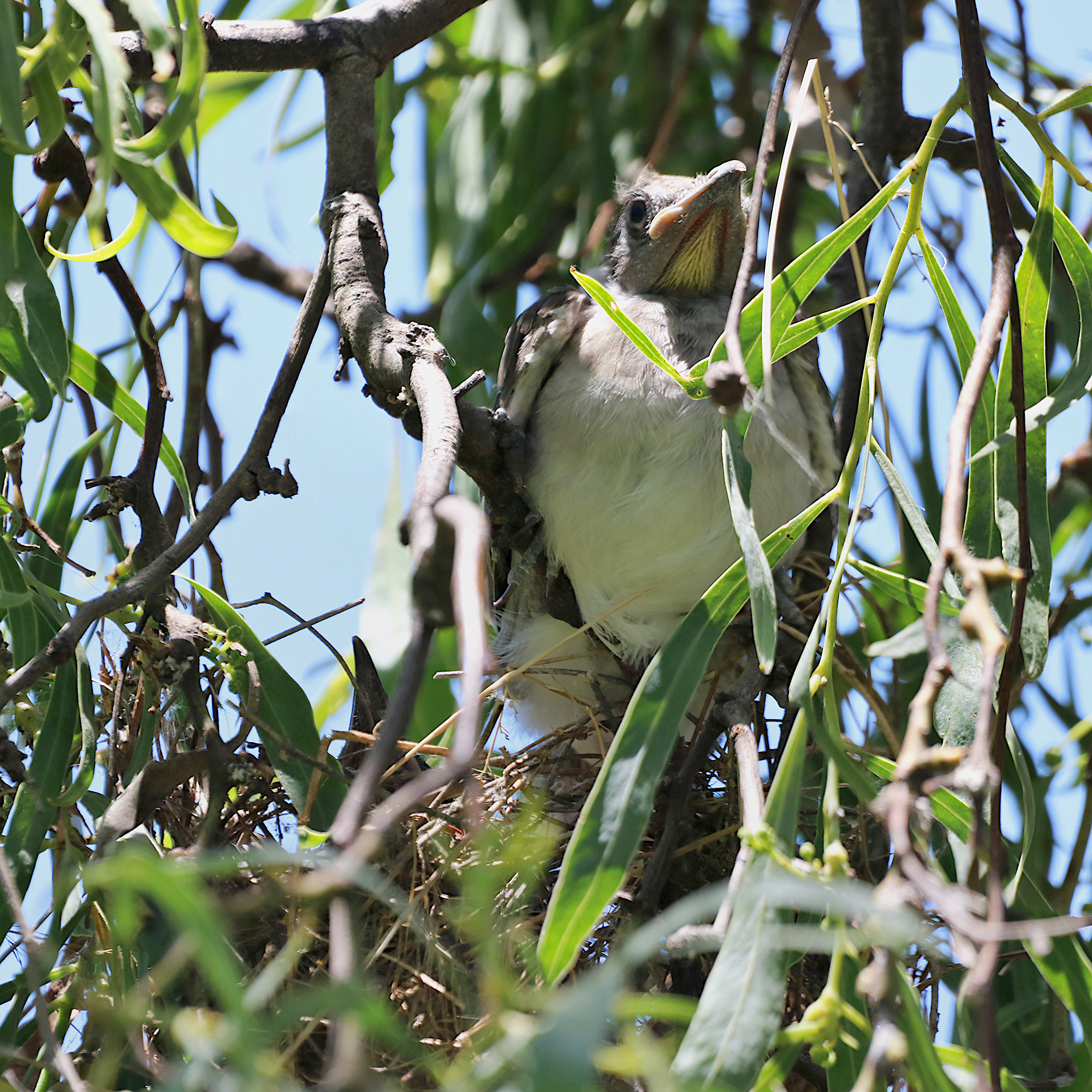
Close-up frontal view of a Little Friarbird chick ready to leave
its nest; its sibling is still down inside the nest
[Eulah Creek, NSW, December 2024]
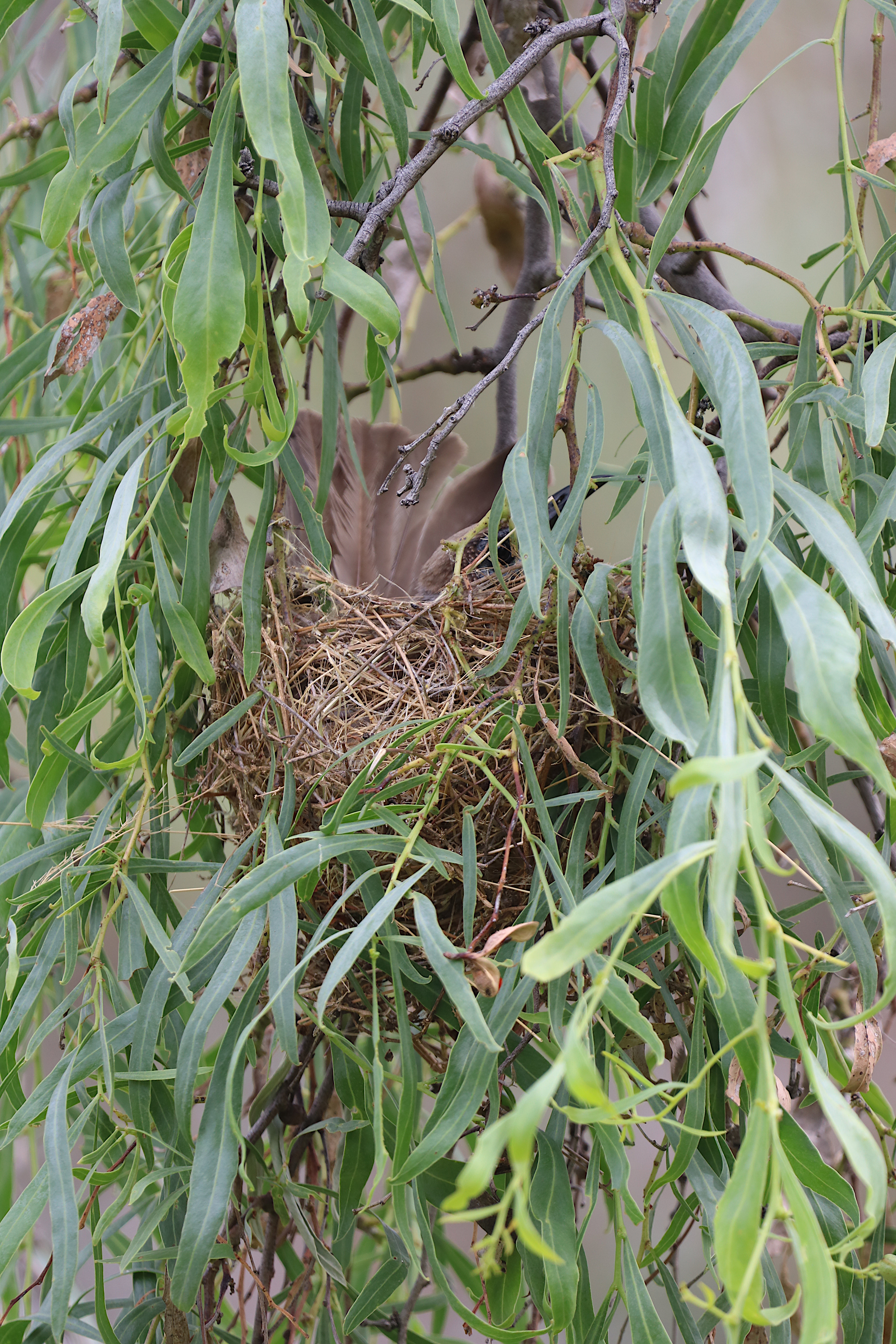
Close-up near-frontal view of a Little Friarbird in its nest,
incubating
[Eulah Creek, NSW, November 2024]

Lateral view of a Little Friarbird entering its nest
[Eulah Creek, NSW, December 2010]

Close-up view of a Little Friarbird peeking out of its nest
to see what is going on underneath
[Eulah Creek, NSW, December 2010]

Lateral view of a fledgling Little Friarbird that fell
out of a tree on the day of leaving the nest; that day
190 mm of rain fell, which is why the bird is soaking
wet and could not fly back up into the tree just yet
[Eulah Creek, NSW, February 2012]

Before being put back on a tree branch by us (while the rescuer
copped a sustained attack by the parents), the fledgling Little
Friarbird was fed on the ground
[Eulah Creek, NSW, February 2012]
Little Friarbirds were seen by us nesting quite late in the 2010/11 breeding season, when building their nest in December and starting to sit on their eggs in the second half of December. But they had their first clutch out in no time and were busy feeding chicks again already by mid-February. The second nest was built in the same tree (Acacia salicina) as the first of the season, but hanging from a different branch.
 |
Additional information |
To see a sequence of photos showing the activities of an adult bird at its nest, click here.
|
|
Additional information |
Little Friarbirds like to take advantage of the protection offered by nesting under an Australian Magpie nest. There is now a separate page about various bird species nesting under the umbrella of a stronger, protective species.
|
|
Eggs |
"boyanga", "booyanga", "derinya", "dirandil", "koomura", "mirk", "ngampu", "nooluk", "pateena", "pum-pum" = Egg; "dirundirri" = eggs [Aboriginal]; "gawu" = eggs [gamilaraay] |
| Size: 27 x 20 mm | Colour: Creamy, with copious chestnut speckles | Shape: Tapered oval |
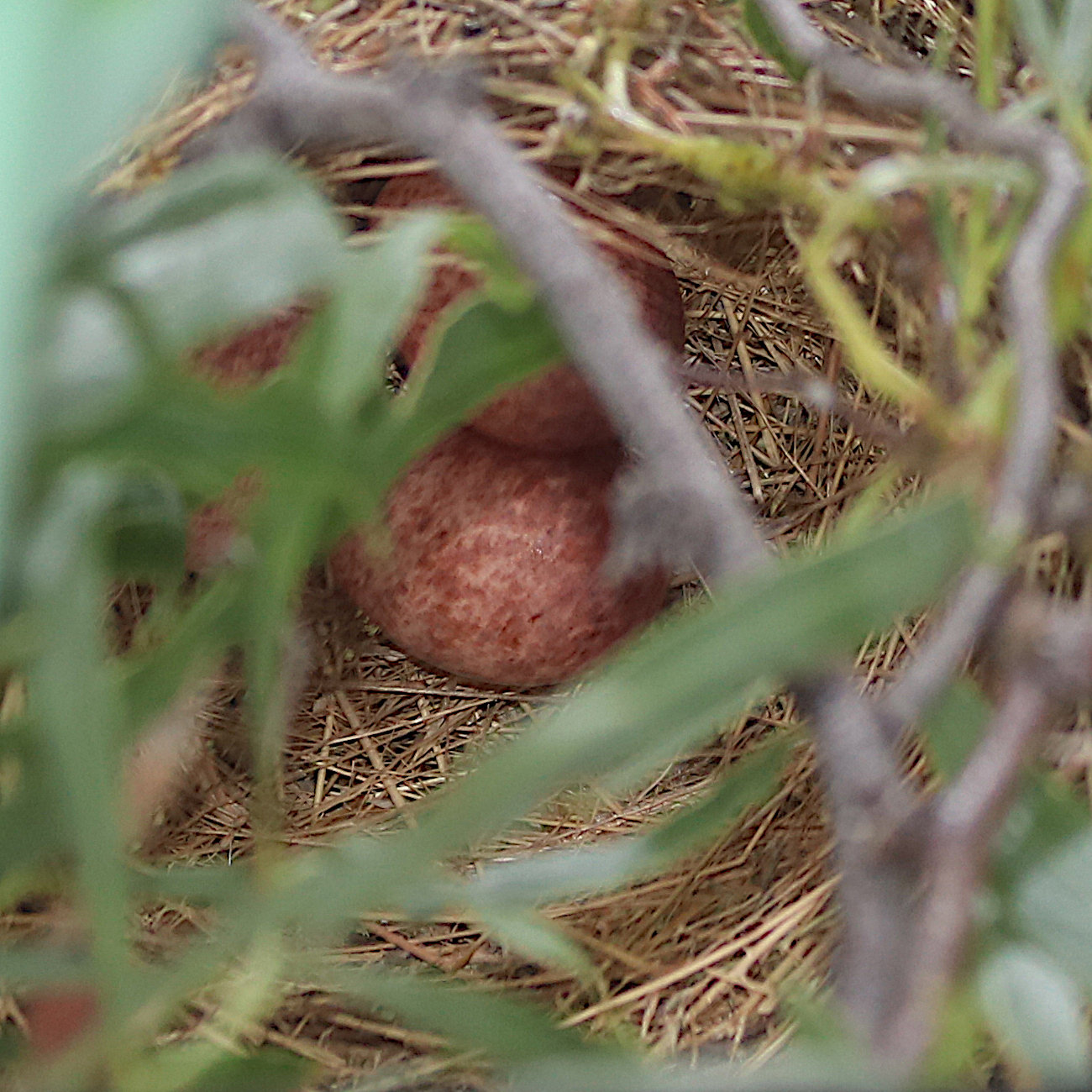
View from above (photo taken with a mirror) into a
Little Friarbird nest with 3 eggs inside
[Eulah Creek, NSW, November 2024]
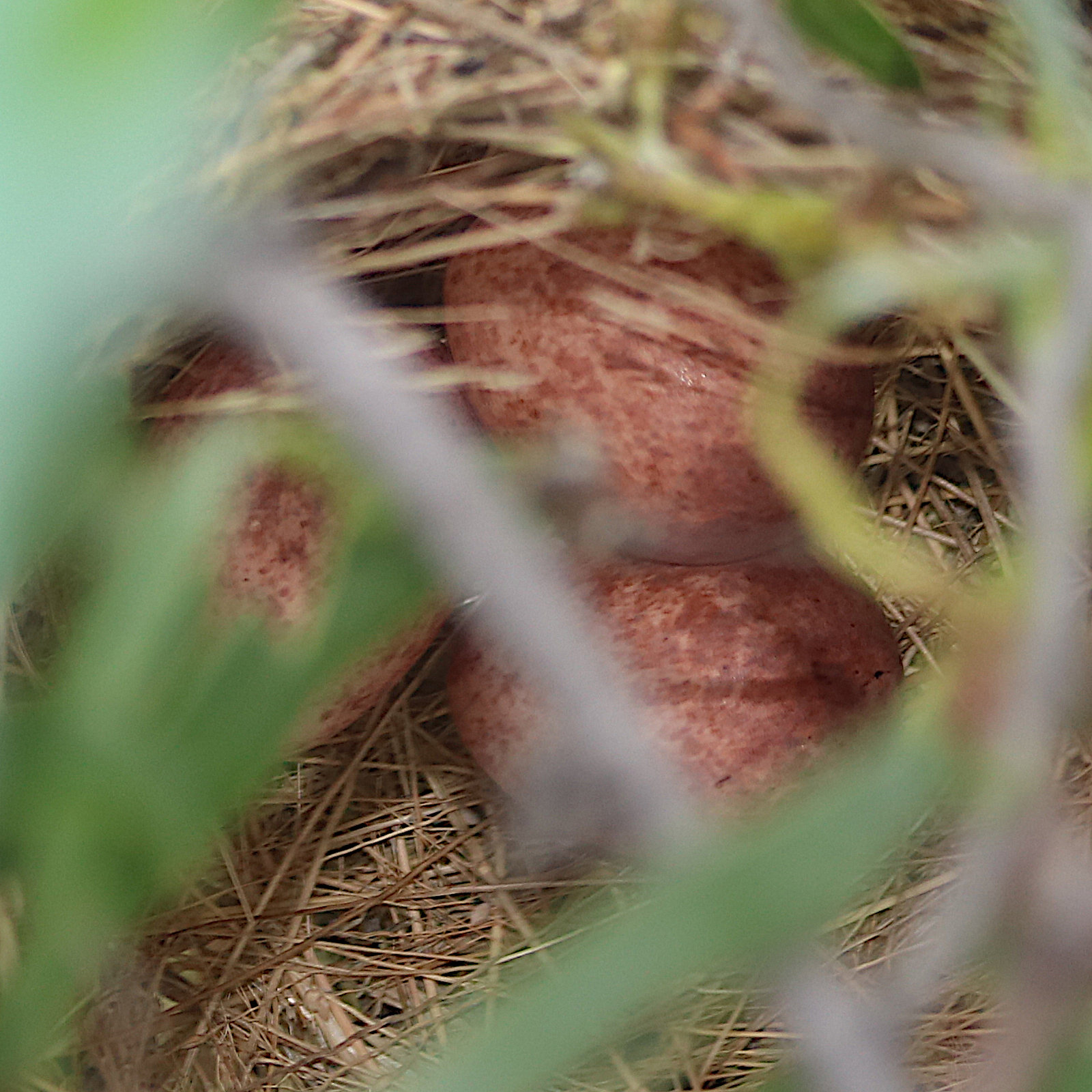
Closer look at 3 eggs in a Little Friarbird nest
[Eulah Creek, NSW, November 2024]
|
|
Behaviour |
| Social behaviour: Territorial | Mobility: Migratory/dispersive | Elementary unit: Solitary/pair |
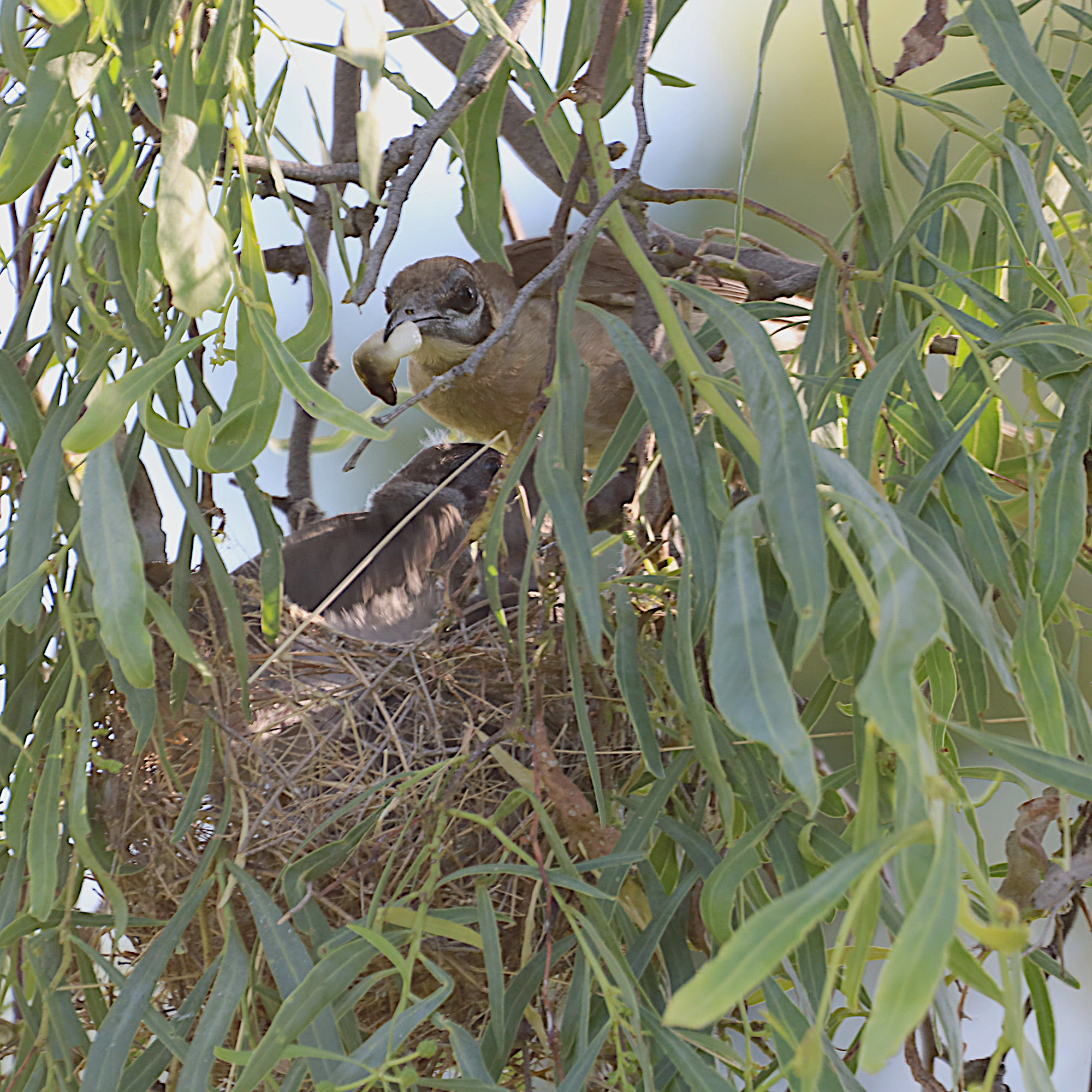
Example of a Little Friarbird parent
keeping its nest clean
by removing a poo sac discharged by one of the chicks
[Eulah Creek, NSW, December 2024]
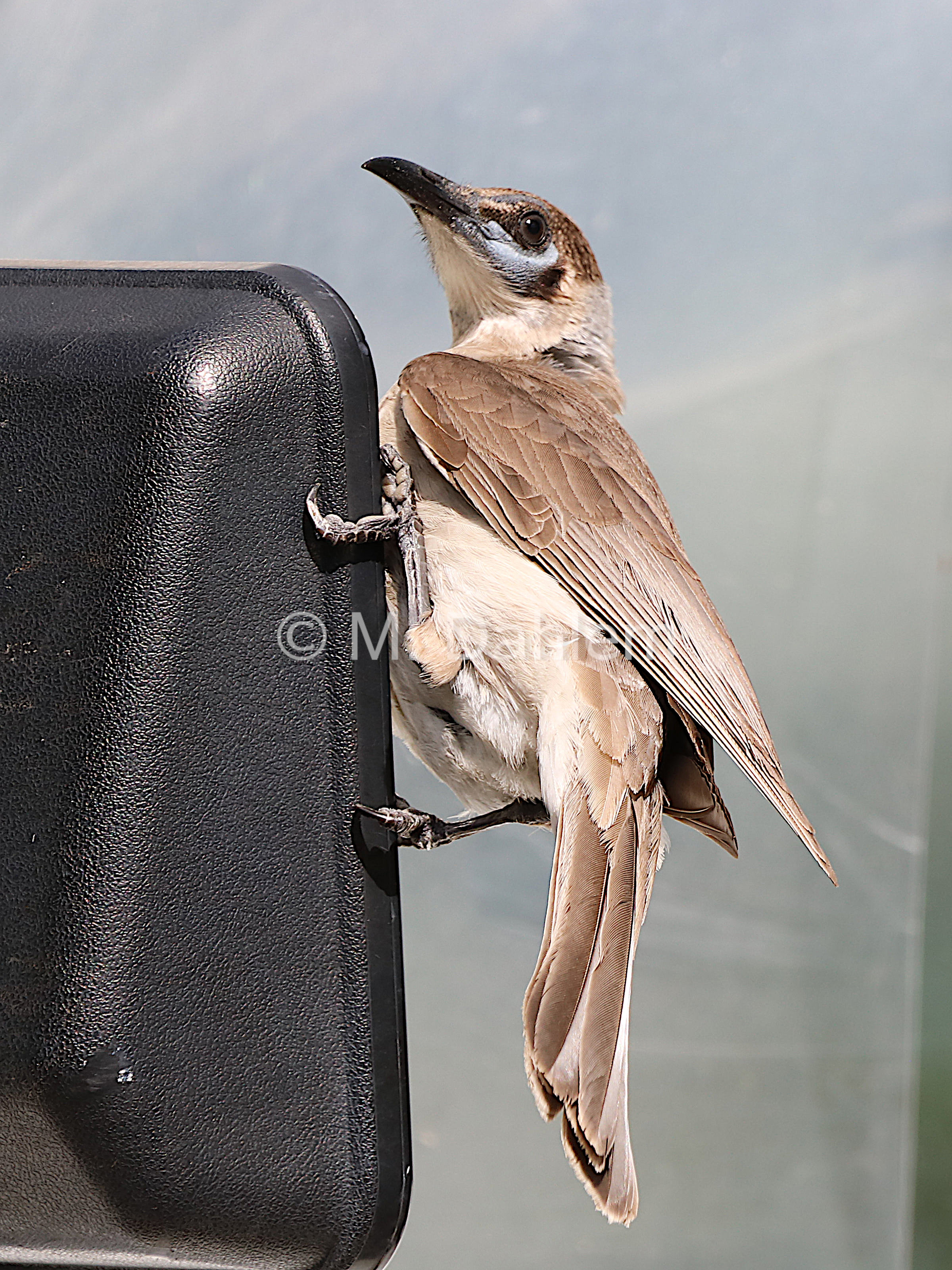
Near-dorsal/ventral view of a Little Friarbird fighting the
"competition" in a mirror
[Eulah Creek, NSW, November 2025]
Little Friarbirds protect their nest and its surroundings with determination, also against much more powerful birds, such as e.g. Australian Magpies.

Little Friarbird harassing a
Brahminy Kite
(photo courtesy of B. Hensen)
[Darwin, NT, January 2016]
|
|
Food, Diet |
| Adults: Nectar, insects | Dependents: Insects | Water intake: Daily |
Like many other honeyeaters, Little Friarbirds do not exclusively feed on nectar, but use their sticky tongue to take insects too.

Little Friarbird feeding on nectar from the flowers of a
lemon-scented eucalypt
[Eulah Creek, NSW, June 2012]

View onto the upperparts of a Little Friarbird taking nectar from a
bottlebrush
(photo courtesy of B. Hensen)
[Darwin, NT, March 2013]

View onto the underparts of a Little Friarbird taking nectar from a
bottlebrush
(photo courtesy of B. Hensen)
[Darwin, NT, March 2013]

Close-up frontal portrait of a Little Friarbird taking nectar from a
bottlebrush,
with pollen stuck to the front of its head
[Eulah Creek, NSW, October 2022]

Close-up near-frontal portrait of a Little Friarbird taking nectar from a
bottlebrush,
with pollen stuck to the front of its head
[Eulah Creek, NSW, September 2022]

Close-up lateral view of a Little Friarbird taking nectar from a
bottlebrush,
with pollen stuck to the front of its head
[Eulah Creek, NSW, September 2022]

Close-up lateral view of a Little Friarbird taking nectar from a
bottlebrush,
with pollen stuck to the front of its head
[Eulah Creek, NSW, September 2022]

Close-up lateral view of a Little Friarbird taking nectar from a
bottlebrush
[Eulah Creek, NSW, October 2022]

Near-dorsal view of a Little Friarbird displaying behaviour
typical of a flycatcher,
hunting off a low perch
[Eulah Creek, NSW, October 2011]
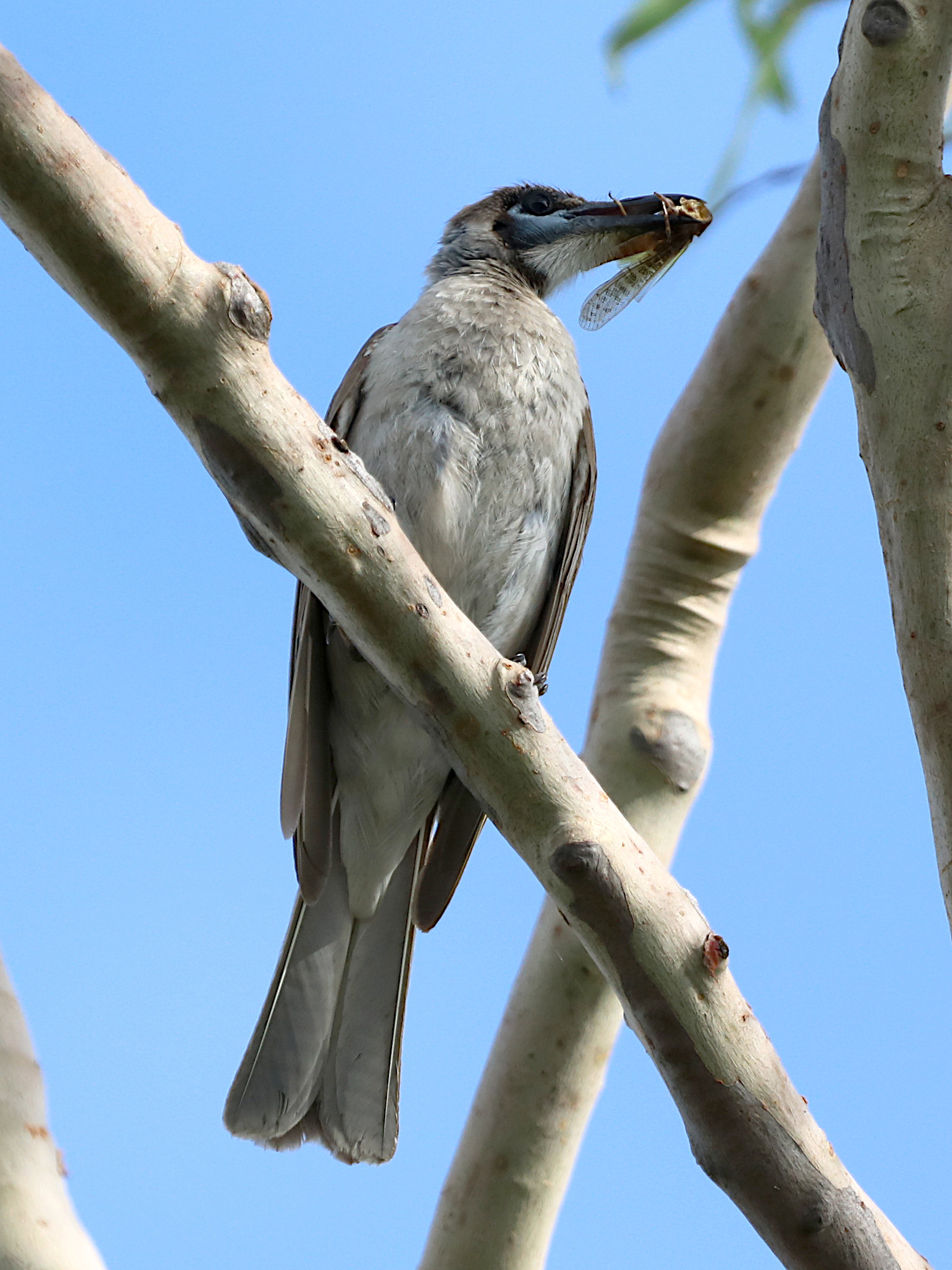
Near-frontal/ventral view of a Little Friarbird with its
catch, a locust
[Eulah Creek, NSW, November 2024]

Near-dorsal view of a Little Friarbird with its prey, a cicada
(photo courtesy of P. Brown)
[Darwin, NT, January 2018]

Lateral view of a Little Friarbird whacking the wings off a
dragon fly before feeding it to one of its nestlings
[Eulah Creek, NSW, January 2016]

Lateral view of a Little Friarbird hunting insects on the ground
[Eulah Creek, NSW, October 2011]

Frontal view of a Little Friarbird looking sideways, first
securing the left side...
[Eulah Creek, NSW, September 2007]

... then the right...
[Eulah Creek, NSW, September 2007]

Frontal view of a Little Friarbird having a drink at the local
bird bath
[Eulah Creek, NSW, September 2007]

Dorsal view of a Little Friarbird making proper use
of a water fountain
[Darwin, NT, August 2014]
|
|
Additional information |
In the case of Little Friarbirds we know that they feed their chicks with insects only. For more information, click here.
|
|
Call(s)/Song |
For this species we have recorded the following call(s)/song. The
interpretation of their meaning is our own;
comments and suggestions for improvement  are welcome.
| ltfriar_20210808_2.m4a |
citreogularis (NW NSW) |
Contact calls | © MD | |
| ltfriar_20210808.m4a |
citreogularis (NW NSW) |
Contact calls (Q&A) | © MD | |
| ltfriar_20151222.m4a |
citreogularis (NW NSW) |
Territorial song (male display flight) | © MD | |
| ltfriar_20151021.m4a |
citreogularis (NW NSW) |
Territorial call? | © MD | |
| ltfriar_20170905_4.m4a |
citreogularis (NW NSW) |
Territorial call? | © MD | |
| ltfriar_20190722.m4a |
citreogularis (NW NSW) |
Territorial call? | © MD | |
| ltfriar_20200531.m4a |
citreogularis (NW NSW) |
Squabbling | © MD | |
| ltfriar_20200531_2.m4a |
citreogularis (NW NSW) |
Squabbling | © MD | |
| ltfriar_art_20140929.m4a |
citreogularis (SE QLD) |
Feeding calls | © ART | |
| ltfriar_20180129.m4a |
citreogularis (NW NSW) |
Begging calls (juvenile) | © MD | |
| ltfriar_20170802.m4a |
citreogularis (NW NSW) |
Various | © MD | |
| ltfriar_20170905_2.m4a |
citreogularis (NW NSW) |
Defending food source? | © MD | |
| ltfriar_20161218.m4a |
citreogularis (NW NSW) |
? | © MD | |
| ltfriar_20150813.m4a |
citreogularis (NW NSW) |
? | © MD | |
| ltfriar_20150905.m4a |
citreogularis (NW NSW) |
? (Q&A) | © MD | |
| ltfriar_cp_20260613.m4a |
sordidus (N WA) |
? | © CP |
We have also recorded a Little Friarbird tapping a mirror when fighting against the competition it could see there.
| ltfriar_20251104.m4a |
citreogularis (NW NSW) |
(Fighting with competition) | © MD |
More Little Friarbird sound recordings are available at
xeno-canto.org
 .
.
These pages are largely based on our own observations and those of our contributors. The structure of these bird pages is explained HERE. For more salient facts on any bird species please refer to a field guide.
|
Would you like to contribute photos or sound recordings to this
site?
If interested, please CLICK HERE. Credits to contributors are given HERE. |
Disclaimer:
Comments are always welcome. We give no guarantee
that the information presented on these pages is always correct or
up-to-date. External links are marked as such and we take no
responsibility for the contents of external pages.
All images on this site are protected by copyright & used by permission
of the respective owners. If you wish to reproduce them or any of the
material presented on this website, please contact us:
We hereby acknowledge the original custodians of the land which is
described on these pages, including the Gomeroi/Gamilaraay people
of the North-west Slopes and Plains of NSW, and the traditional
owners of other lands and nations within this country. We acknowledge
elders past, present and emerging. Sovereignty was never ceded.
Last updated:
Sat, 29 August 2026, 7:04 +00:00