8 |
|
Hudsonian GodwitSize: 37-42 cm; wing span ca. 75 cm (average) Body mass: 300 g (average) |
 |
Similar |


|
 Description  Classification  Distribution  Sightings  Photos  Breeding  Nest  Eggs  Behaviour  Food  Call/s |
|
 Click here for a physical description |
|
||||||
|
Click here for information on habitat
and range
|
Click here for sighting information
|


|
|
Photos |
 |
ADULT |
 |
MALE |
 |
NON-BREEDING |

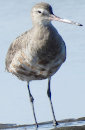
Near-frontal view of a Hudsonian Godwit in transitional
plumage
looking towards the observer
(photo courtesy of M. Eaton)
[Brighton, Brisbane, QLD, June 2024]

Near-frontal view of a Hudsonian Godwit in transitional
plumage
(photo courtesy of M. Eaton)
[Brighton, Brisbane, QLD, June 2024]

Lateral view of a Hudsonian Godwit in transitional
plumage
(photo courtesy of M. Eaton)
[Brighton, Brisbane, QLD, June 2024]

Lateral view of a Hudsonian Godwit in transitional
plumage
(photo courtesy of M. Eaton)
[Brighton, Brisbane, QLD, June 2024]

Near-dorsal view of a Hudsonian Godwit in transitional
plumage
(photo courtesy of M. Eaton)
[Brighton, Brisbane, QLD, June 2024]

Dorsal/ventral view of a Hudsonian Godwit in transitional
plumage
(photo courtesy of M. Eaton)
[Brighton, Brisbane, QLD, June 2024]

Lateral comparison of a Hudsonian Godwit in transitional
plumage,
right, with two
Bar-tailed Godwits
in non-breeding plumage
and a Silver Gull
(photo courtesy of M. Eaton)
[Brighton, Brisbane, QLD, June 2024]

Comparison of a Hudsonian Godwit in transitional
plumage,
right, with a
Bar-tailed Godwit
in non-breeding plumage
(photo courtesy of M. Eaton)
[Brighton, Brisbane, QLD, June 2024]
|
|
Food, Diet |

Lateral view of a Hudsonian Godwit in transitional
plumage
pulling its prey out of mud and water
(photo courtesy of M. Eaton)
[Brighton, Brisbane, QLD, June 2024]

Lateral view of a Hudsonian Godwit in transitional
plumage
pushing its bill into the mud right "up to the hilt"
(photo courtesy of M. Eaton)
[Brighton, Brisbane, QLD, June 2024]
These pages are largely based on our own observations and those of our contributors. The structure of these bird pages is explained HERE. For more salient facts on any bird species please refer to a field guide.
|
Would you like to contribute photos or sound recordings to this
site?
If interested, please CLICK HERE. Credits to contributors are given HERE. |
Disclaimer:
Comments are always welcome. We give no guarantee
that the information presented on these pages is always correct or
up-to-date. External links are marked as such and we take no
responsibility for the contents of external pages.
All images on this site are protected by copyright & used by permission
of the respective owners. If you wish to reproduce them or any of the
material presented on this website, please contact us:
 We hereby acknowledge the original custodians of the land which is
described on these pages, including the Gomeroi/Gamilaraay people
of the North-west Slopes and Plains of NSW, and the traditional
owners of other lands and nations within this country. We acknowledge
elders past, present and emerging. Sovereignty was never ceded.
Last updated:
Sat, 29 August 2026, 5:49 +00:00