Planetary conjunction May 2011
From late April well into May 2011 a conjunction of four planets could be observed with the unaided eye near the eastern horizon just before sunrise. In the photos and diagrams below Jupiter, Mars, Venus and Mercury can be seen. This leaves only one other visual planet, Saturn, invisible. A conjunction involving all five visual planets will be observable in the western sky, just after sunset, in early September 2040.
Sky & Telescope created a nice little animation showing the planet's positions with respect to each other over the period of visibility. To view the animation, please click here.
NOTE: This animation is for northern latitudes, whereas we observed the conjunction from Narrabri, NSW, Australia, at -30 degrees geographical latitude. One will need to rotate the movie by almost a right angle (and then change the horizon...) to make it match the images taken by us:
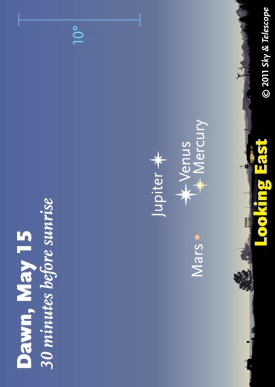
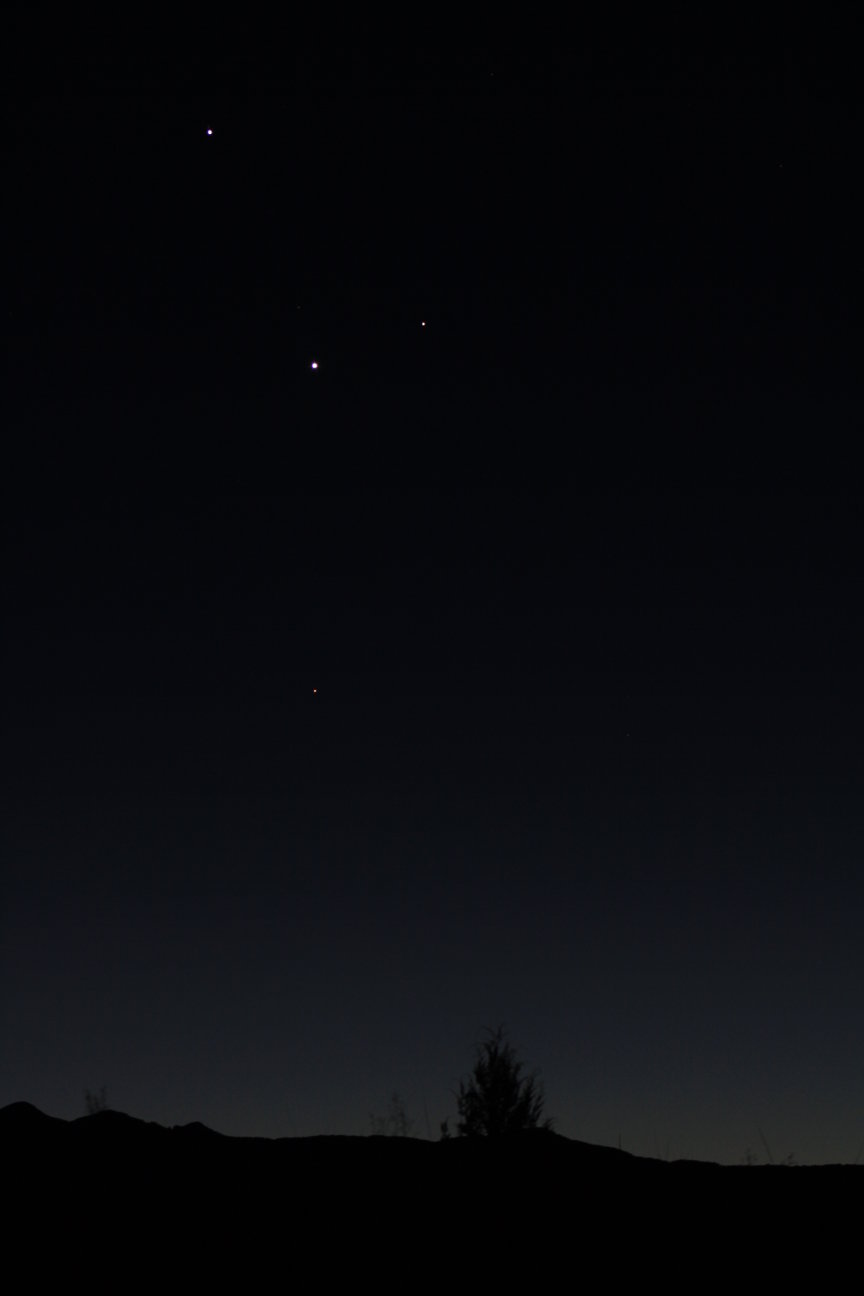
Simulation from Sky & Telescope movie for 15 May 2011 (left) and
our own photo taken on the day (right), for comparison; the landscape
at the horizon is the Nandewar Range near Narrabri, NSW, Australia
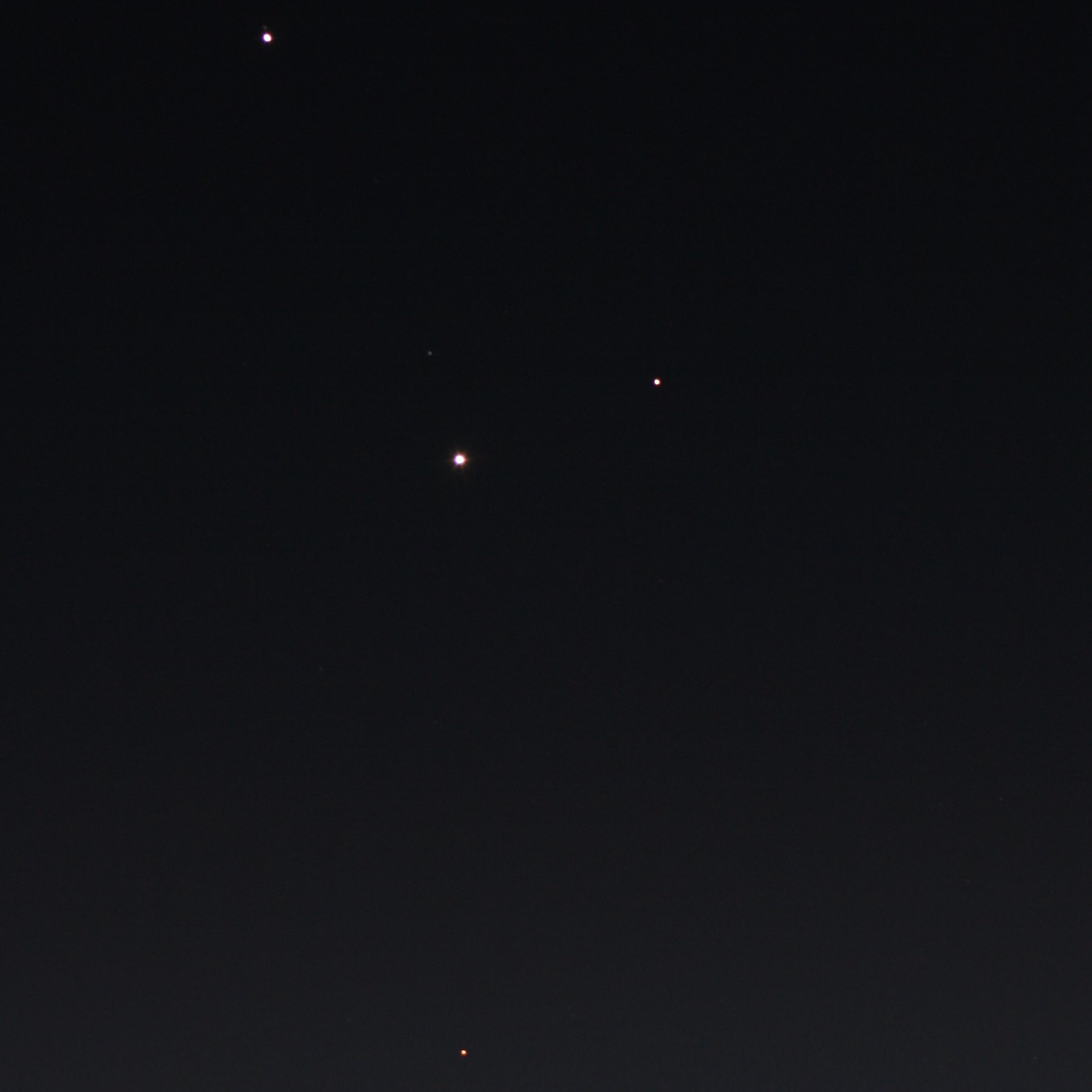
Here the conjunction of the four planets as photographed by us with
a focal length of 75 mm;
Jupiter
is at the top,
Venus
centre left,
Mercury
centre right and
Mars
at the bottom
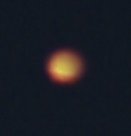
Bringing Mars into the centre of the field of view in order to minimise optical distortions this little image was obtained; this is a 1 s exposure with a 300-mm telelens on a Canon EOS1000D camera. Doesn't look like much, does it? It may be more impressive when you consider that Mars is just about 10000 km across in diameter and at the time of the photo was on the far side of the Sun - that is a distance of 450 million km! And still and off-the-shelf camera that will cost you just a few hundred dollars can show you that it is NOT just a dot but extended. It has a reddish surface and there are colour differences over the disk; not bad, I'd say!
Disclaimer:
Comments are always welcome. We give no guarantee
that the information presented on these pages is always correct or
up-to-date. External links are marked as such and we take no
responsibility for the contents of external pages.
All images on this site are protected by copyright & used by permission
of the respective owners. If you wish to reproduce them or any of the
material presented on this website, please contact us:
 We hereby acknowledge the original custodians of the land which is
described on these pages, including the Gomeroi/Gamilaraay people
of the North-west Slopes and Plains of NSW, and the traditional
owners of other lands and nations within this country. We acknowledge
elders past, present and emerging. Sovereignty was never ceded.
Last updated:
Sat, 4 April 2026, 5:09 +00:00