Comet Leonard (C/2021 A1) and planetary conjunction of December 2021
Even as far as comets are concerned, comet Leonard (C/2021 A1) is out of the ordinary. On a highly elliptical orbit out to 3700 AU (1 AU = the distance of Earth from the Sun, ca. 150 million km), it had not been near the Sun in 80,000 years before being detected in early 2021. If not destroyed in the process, its current pass brings it close enough to the Sun for it to be accelerated to more than "escape velocity", i.e. the speed required for it to escape from the Sun's gravitational potential - it will be ejected.
On the evening of 28 December 2021, around 21:00-21:30 AEDST (10:00-10:30 UTC), comet Leonard (C/2021 A1) was observed and photographed from Narrabri, NSW, Australia. A Canon EOS760D camera was used with an 18-mm lens set at a sensitivity of 1600 ASA.
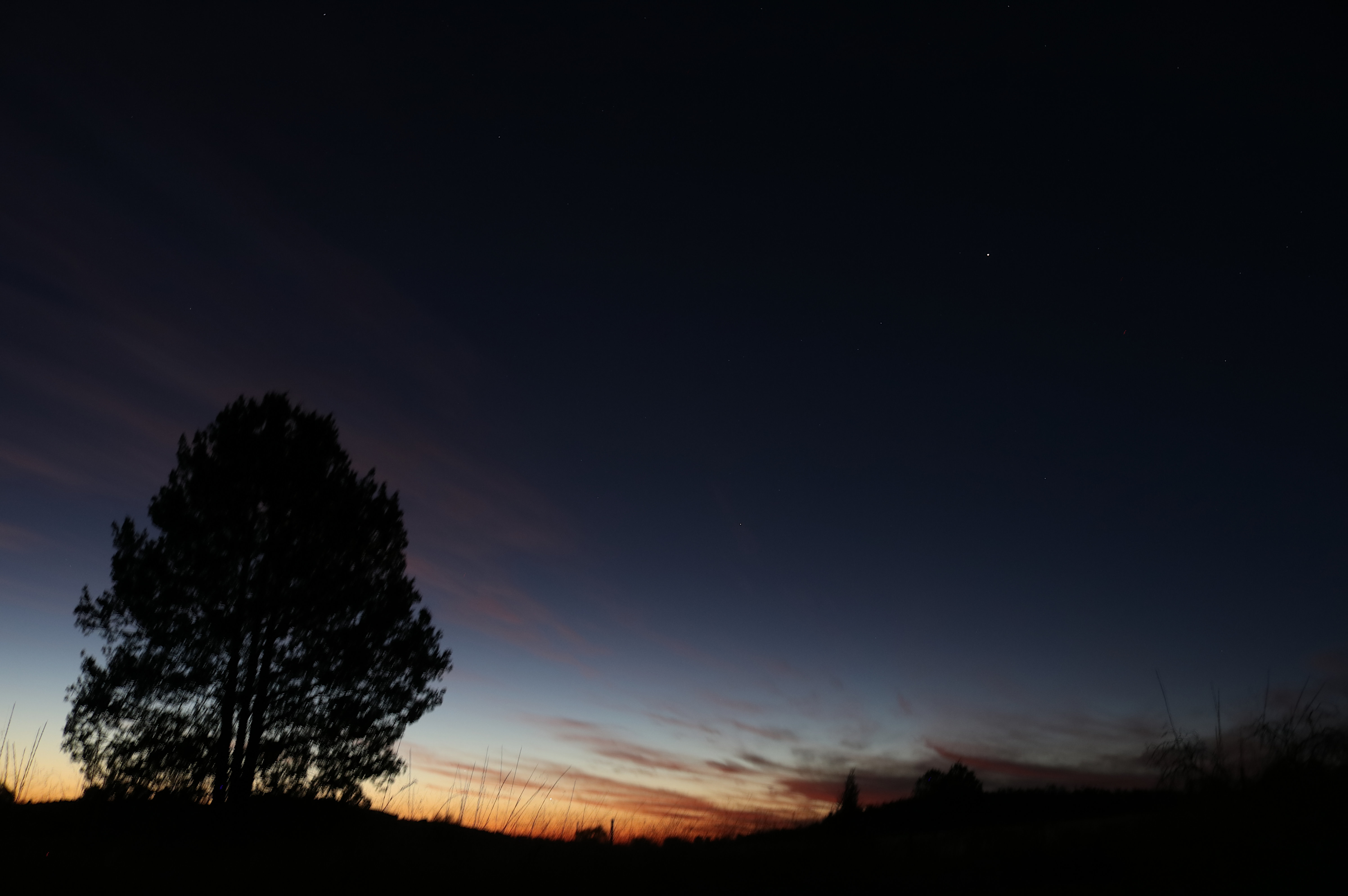
Stack of several short exposures of the western sky from Narrabri, NSW,
Australia on 28 December 2021, around 20:30 AEDST (09:30 UTC) taken with
an 18-mm lens; the visible planets are Mercury and Venus [lower left,
in the brightest area of the sky], Saturn [near the centre] and Jupiter
[upper right]; comet Leonard is also in this field-of-view,
but too faint to be visible - note that the next photo down was taken
AT THE SAME RESOLUTION as the full-size version of this image but cropped
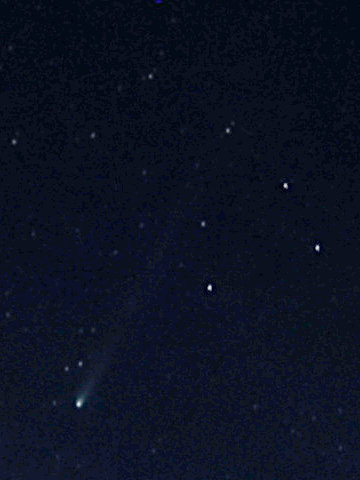
Image of comet Leonard (C/2021 A1) from Narrabri, NSW, Australia on 28 December 2021, around 21:13-21:25 AEDST (10:13-10:25 UTC), obtained by stacking 15 10-second exposures with an 18-mm lens at 1600 ASA; the pixel scale is the same as in the (full size) image above
While looking for and finally observing Comet C/2021 A1 (Leonard), there was an opportunity to also obtain images of 4 planets. These were taken with an off-the-shelf digital single-lens reflex (SLR) camera, a Canon EOS760D, with a 150-600 mm zoom-lens, without tracking, by means of stacking. These photos were taken with the camera hand-held, leaning onto a solid surface.
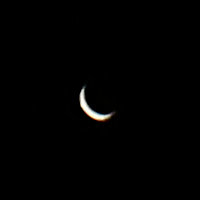
6 individual exposures of 1/400 second, stacked to improve signal-to-noise, of Venus as a thin crescent; 20 December 2021, 19:46 AEDST (8:46 UTC); Canon EOS760D, Sigma 150-600 mm contemporary lens at 200 ASA

4 individual exposures of 1/100 second, stacked to improve signal-to-noise, of Jupiter; 18 December 2021, 19:40 AEDST (8:40 UTC); Canon EOS760D, Sigma 150-600 mm contemporary lens at 200 ASA

Six individual exposures of 1/60-1/100 second, stacked to improve signal-to-noise, of Jupiter; 1 January 2022, 21:23-21:25 AEDST (10:23-10:25 UTC); Canon EOS760D, Sigma 150-600 mm contemporary lens at 1600 ASA - while the planet's surface is overexposed, its Galilean moons Io, Europa, Ganymede and Callisto are now marginally visible
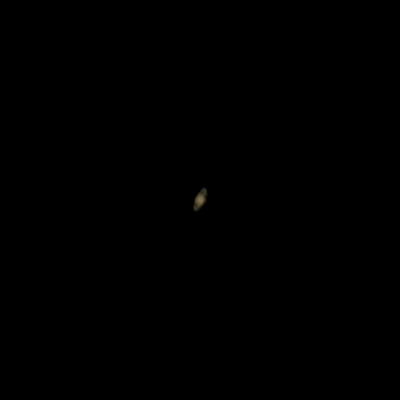
10 individual exposures of 1/400 second, stacked to improve signal-to-noise, of Saturn; 28 December 2021, 20:45 AEDST (9:45 UTC); Canon EOS760D, Sigma 150-600 mm contemporary lens at 1600 ASA
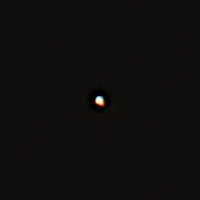
15 individual exposures of 1/400 second, stacked to improve signal-to-noise, of Mercury; 28 December 2021, 20:40 AEDST (9:40 UTC); Canon EOS760D, Sigma 150-600 mm contemporary lens at 1600 ASA
Disclaimer:
Comments are always welcome. We give no guarantee
that the information presented on these pages is always correct or
up-to-date. External links are marked as such and we take no
responsibility for the contents of external pages.
All images on this site are protected by copyright & used by permission
of the respective owners. If you wish to reproduce them or any of the
material presented on this website, please contact us:
 We hereby acknowledge the original custodians of the land which is
described on these pages, including the Gomeroi/Gamilaraay people
of the North-west Slopes and Plains of NSW, and the traditional
owners of other lands and nations within this country. We acknowledge
elders past, present and emerging. Sovereignty was never ceded.
Last updated:
Wed, 18 February 2026, 8:39 +00:00