Basics of Solar eclipses
Some non-astronomers may find it useful to know how a Solar eclipse works. Obviously, the Moon enters the line of sight from us to the Sun. This does not happen every month, because the plane in which the Moon orbits Earth is inclined with respect to the plane in which Earth orbits the Sun. The curious thing is that, at its distance from us of about 400000 km, the apparent size of the Moon is almost the same as that of the Sun, which is much farther away (150 million km). Using two images taken with my digital camera, this can be illustrated quite nicely.
Below I show first an image of the Sun, followed by one of a crescent Moon and then a superposition of the lunar crescent's contours on the image of the Sun.

Image of the Sun, with a sunspot near the upper edge

Image of the Moon, on the same scale
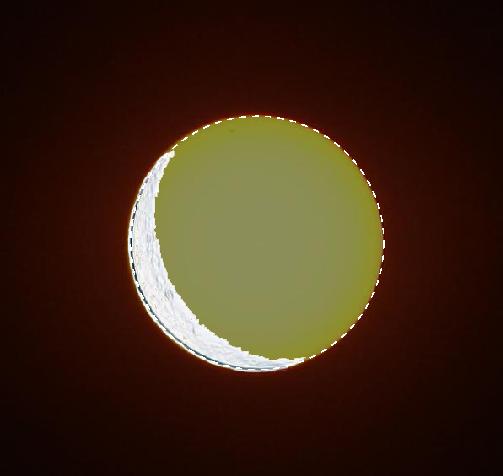
Superposition of the above two images (using only the edges of the Moon as contours), the dashed line indicates the size of the full Moon; many thanks to J. Houldsworth for her help with the overlay
One can imagine how the full Moon (extending its edge to a circle, as indicated by the dashed circle) will just about cover the entire surface of the Sun.
Both Earth's orbit around the Sun and the Moon's orbit around Earth are slightly eccentric. This is the reason why sometimes the Moon is apparently a bit larger than normal, while the Sun is a bit smaller in extent, which potentially leads to a long total eclipse. The match is still so good that an eclipse is "total" only along a very narrow path across Earth's surface, only tens of km wide. When the Moon is at its maximum distance from Earth, it cannot cover the entire surface of the Sun, leading to an annular eclipse, with light coming "around" the Moon to us. In a partial eclipse the Moon is not dead-centre in front of the Sun, scraping past it.
Click here to see a photo of the total Solar eclipse of 11 July 1991.
There are sites providing a lot more detailed information and better explanations of eclipses, for example the following by NASA (external link).
Disclaimer:
Comments are always welcome. We give no guarantee
that the information presented on these pages is always correct or
up-to-date. External links are marked as such and we take no
responsibility for the contents of external pages.
All images on this site are protected by copyright & used by permission
of the respective owners. If you wish to reproduce them or any of the
material presented on this website, please contact us:
 We hereby acknowledge the original custodians of the land which is
described on these pages, including the Gomeroi/Gamilaraay people
of the North-west Slopes and Plains of NSW, and the traditional
owners of other lands and nations within this country. We acknowledge
elders past, present and emerging. Sovereignty was never ceded.
Last updated:
Wed, 18 February 2026, 8:39 +00:00