Time lapse video of Venus's phases
The phases of Venus served as one argument brought forward by Galileo Galilei to prove that Nicolaus Copernicus's heliocentric world model was correct, rather than the geocentric model. Observing the phases of Venus, Galilei could prove that these were only consistent with the Sun being at the centre of the planetary system and that the planets (and the Sun) could not orbit Earth.
All photos shown here (with the exception of the overview, below) were taken (hand-held) with a Canon EOS760D camera with a 24-MP CCD and a Sigma 150-600 mm contemporary zoom tele-lens. Individual exposure times range from 1/1000 s at 200 ASA, when Venus was brightest, to 1/400 s when it was faint (for all epochs a few photos were stacked in order to improve the signal-to-noise ratio). The photos, displayed at 0.5-second intervals, create a time lapse video of Venus's changing phases. The sequence starts around maximum eastern elongation (when Venus was near "half" phase), on 26 July 2026, and runs to when Venus came too close to the Sun to be imaged. The inferior conjunction was on 24 October 2026. Venus was acquired again in the morning sky prior to sunrise on 27 October 2026.
On the eastern side of the Sun, Venus is visible in the evening sky, (most prominently) after sunset. While on that side, Venus is coming towards Earth, so over time it will become apparently bigger in angular extent, while the part that is illuminated by the Sun becomes smaller - its phase is "waning".
Venus's orbit around the Sun has a radius of roughly 90-110 million km. With Earth's orbit being at ca. 150 million km, our distance to Venus can range from roughly 40 to 260 million km (these numbers are approximate; because of the eccentricity of Venus's orbit the extremes do not apply during every orbit). Hence, as Venus and Earth move around the Sun, the distance between the two planets changes and thereby Venus's apparent size - it ranges from about 10" to ca. 60".
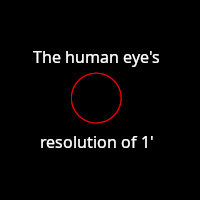
Since the human eye's angular resolution is limited to about 1' (arc minute), and Venus's maximum angular extent when closest to us (and then invisible) is just about 1' (61"), we always - irrespective of brightness or shape - see Venus only as a white spot on the sky.
Once Venus has passed in front of the Sun (and cannot be photographed for a while), it reappears on the western side of the Sun. Then it is visible on the morning sky, starting before sunrise. During this part of its orbit, while it is moving away from us (and becoming apparently smaller), Venus's phase is "waxing".
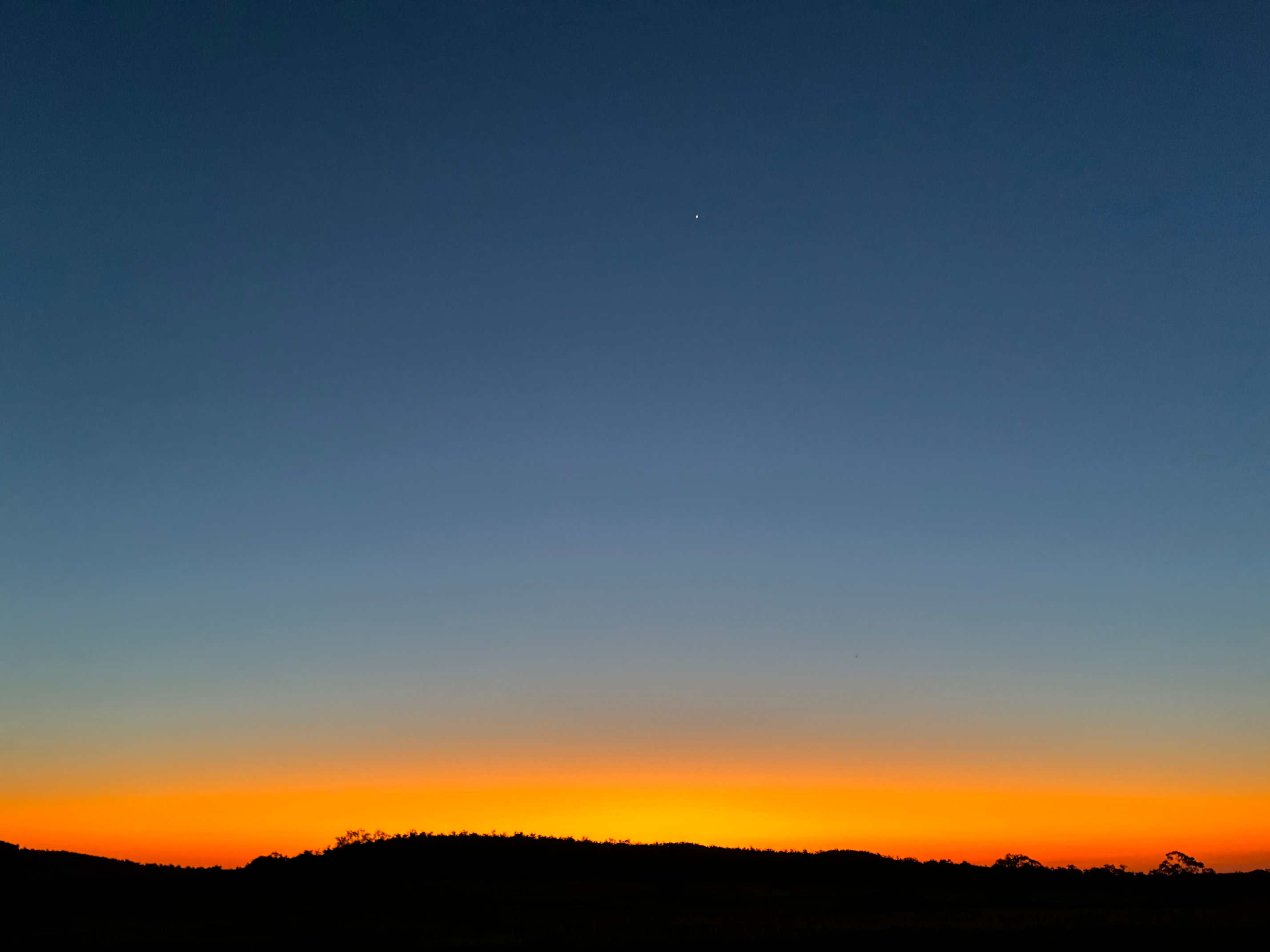
Overview of the western sky just after sunset on 8 Sep. 2026, as
seen from near Narrabri, NSW, Australia; Venus is visible as a
bright spot near the top
Disclaimer:
Comments are always welcome. We give no guarantee
that the information presented on these pages is always correct or
up-to-date. External links are marked as such and we take no
responsibility for the contents of external pages.
All images on this site are protected by copyright & used by permission
of the respective owners. If you wish to reproduce them or any of the
material presented on this website, please contact us:
 We hereby acknowledge the original custodians of the land which is
described on these pages, including the Gomeroi/Gamilaraay people
of the North-west Slopes and Plains of NSW, and the traditional
owners of other lands and nations within this country. We acknowledge
elders past, present and emerging. Sovereignty was never ceded.
Last updated:
Thu, 19 November 2026, 3:22 +00:00