Astronomical Telescopes
Imaging Cameras
Astronomical cameras are the instruments that are easiest to understand, because they are similar to equipment used for photography.
In the past, instead of film rolls, astronomers have used photographic plates (like photographers in the early days). But astronomical plates used emulsions with much higher light sensitivity than commercial products. For various reasons, mostly because of their limited dynamic range, photographic plates are not used a lot anymore in astronomy.
The standard type of cameras used on astronomical telescopes these days are digital CCD (Charge-Coupled Device) cameras, as one can now buy them in stores, in video cameras. The basic technology is the same, albeit with different sensitivities. Astronomers have been using high-sensitivity CCD cameras for some time. Standard sizes are 1024x1024 or 2048x2048 pixels. For wide-field imaging arrays of several CCD chips might be used in mosaics with up to 8000x8000 pixels.
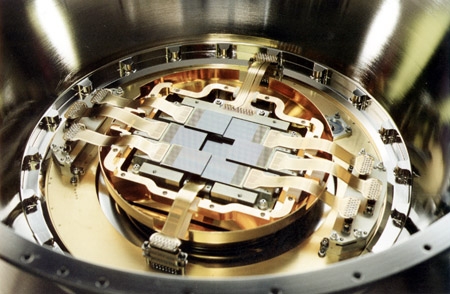
A single CCD may be too small to cover a telescope's entire field-of-view. The photo below shows an example of an astronomical camera made of a mosaic of seven 800x800 pixel individual CCDs.
|
Array of 7 800x800 pixel CCD chips forming a camera used onboard the XMM-Newton satellite for imaging X-rays (figure reproduced from the XMM-Newton Users Handbook, with kind permission of the XMM Science Operations Centre). |
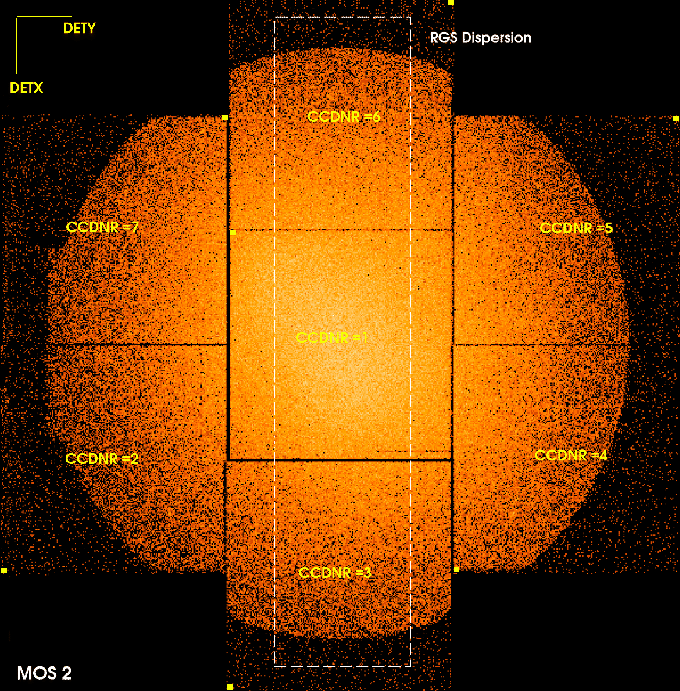
Such an instrumental setup, at the back of one of XMM-Newton's X-ray telescopes, leads to a field-of-view on the sky as shown in the next figure.
|
Field-of-view of one CCD camera onboard the XMM-Newton satellite (click on image for larger version). Figure reproduced from the XMM-Newton Users Handbook, with kind permission of the XMM Science Operations Centre. |
Filters
Normally, it is not really useful for astronomers to observe all incoming light from a source across the spectrum in one exposure, but one will want to know the object's emission characteristics in a certain wavelength range. To observe light in well-defined wavelength ranges one uses sets of filters in front of the cameras.
For example, in order to obtain a true colour image of an object, say a galaxy, one would obtain images with different filters, such as red, blue and yellow. From these, by combining the exposures in a well-defined way, one would reconstruct a colour image. Examples of true-colour images are shown, e.g., on the pages of the Hubble Space Telescope picture album.
This technique is used, because most CCD cameras can only record how much light falls onto each pixel during an exposure, but not what wavelength/colour each pixel had. There are now CCD cameras (for X-rays) that do measure not only how much light falls on each individual pixel, but also the arrival times of photons and their individual energies. With these devices one can therefore obtain colour information in one single exposure. For more information about this, please have a look at the page about multi-dimensional datasets.
Disclaimer:
Comments are always welcome. We give no guarantee
that the information presented on these pages is always correct or
up-to-date. External links are marked as such and we take no
responsibility for the contents of external pages.
All images on this site are protected by copyright & used by permission
of the respective owners. If you wish to reproduce them or any of the
material presented on this website, please contact us:
 We hereby acknowledge the original custodians of the land which is
described on these pages, including the Gomeroi/Gamilaraay people
of the North-west Slopes and Plains of NSW, and the traditional
owners of other lands and nations within this country. We acknowledge
elders past, present and emerging. Sovereignty was never ceded.
Last updated:
Wed, 18 February 2026, 8:53 +00:00