Dust in galaxies
Dust is a special part of the ISM in galaxies, partly because already its creation is still poorly understood. It is also an important coolant. It can absorb a lot of radiation and energy.
Another interesting fact about dust is that we cannot only detect it by its radiation, most of which is emitted at far-infrared wavelengths, but it is also easily detectable in absorption, because it is a very efficient absorber of optical (and ultra-violet) light. In our Galaxy dust is visible with the unaided eye at dark sights on the southern hemisphere in the Milky Way band. Dust is normally found to be associated (also spatially correlated) with cold neutral (i.e., molecular) gas. This is also the case in the halos of spiral galaxies.
The nearby starburst galaxy NGC 253 is one of very few galaxies in which dust has been detected in emission in the halo, namely in the far-infrared wavelength regime (see image below).
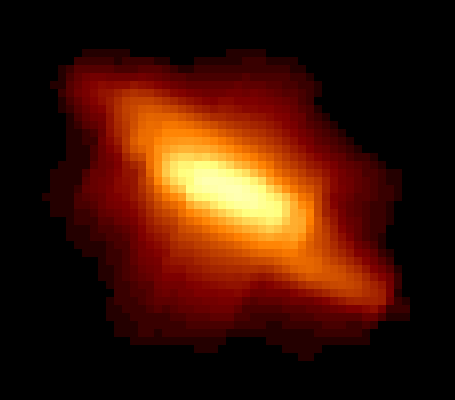
A 60 micron far-infrared image of NGC 253 obtained by the IRAS satellite. Compare the emission distribution with the optical image below. The field of view of both images is comparable. The 60 micron image looks smoother than the optical one because of the inferior angular resolution of IRAS in the infra-red regime compared to optical telescopes. Dust is normally very clumpy, as can be seen by the distribution of dark patches in the optical image.
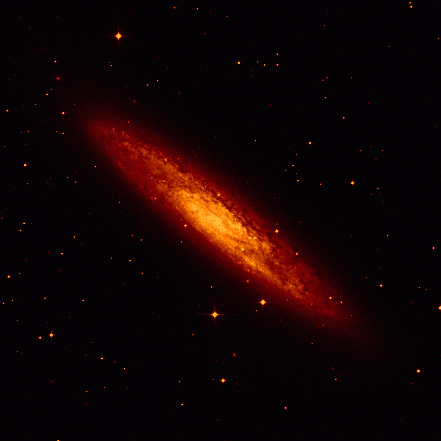
Optical image of NGC 253 from the Digital Sky Survey (DSS). One can see that the optically visible disk is much narrower than the dust distribution visible in its far-infrared emission (above).
The presence of dust as an absorber in the halo in external galaxies is noticeable, because there are apparently less background objects in areas where other components of gaseous halos have been found around edge-on spiral galaxies.
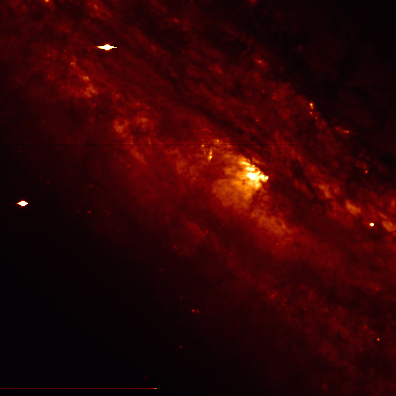
Within the galaxy disks dust is also a prominent absorber of light, as visible in the optical image of NGC 253 displayed above. Here another close-up view of the central part, exhibiting the wealth of dust in this nearby galaxy.
Disclaimer:
Comments are always welcome. We give no guarantee
that the information presented on these pages is always correct or
up-to-date. External links are marked as such and we take no
responsibility for the contents of external pages.
All images on this site are protected by copyright & used by permission
of the respective owners. If you wish to reproduce them or any of the
material presented on this website, please contact us:
 We hereby acknowledge the original custodians of the land which is
described on these pages, including the Gomeroi/Gamilaraay people
of the North-west Slopes and Plains of NSW, and the traditional
owners of other lands and nations within this country. We acknowledge
elders past, present and emerging. Sovereignty was never ceded.
Last updated:
Wed, 18 February 2026, 9:01 +00:00