Magnetic fields in galaxies
The information about cosmic rays (CRs) makes it clear that there is a tight connection between CRs and magnetic fields (B-fields). Magnetic fields determine the way CRs can move most easily and CRs are the charged particles carrying the magnetic field. One cannot live without the other in galaxies and their halos.
How can one measure magnetic fields? This is possible because - when spiralling magnetic field lines - there is a higher probability of CRs emitting photons (which can also be described as electromagnetic waves), with their wave pattern oriented in a certain direction. This behaviour of photons is called "polarization". Polarized radio synchrotron emission allows us to determine the direction of the magnetic field that is influencing the motions of the CRs emitting the light that we are receiving.
As an example, two radio images, obtained at different observing frequencies, of the starburst galaxy NGC 4666 are shown here. What is shown is one image at a frequency of 4.9 GHz (6 cm wavelength) on the left and one at 1.4 GHz (20 cm wavelength) on the right. The little bars indicate the preferred direction of the waves' pattern orientation. These are so-called "electric vectors".
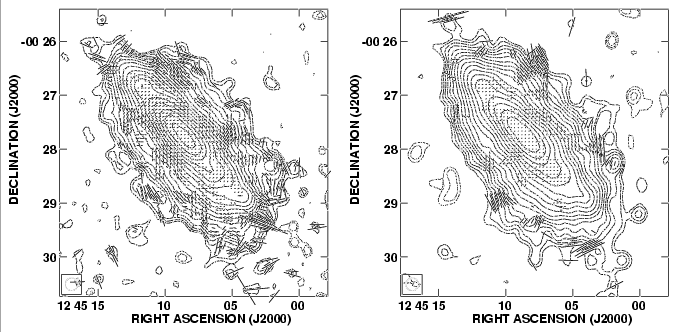
The direction of the true magnetic field, after correction for effects in our own Galaxy influencing the polarized light on its way to us, is aligned perpendicular to the measured electric vectors. The bars in the figure below thus represent the true "magnetic vectors". In this particular case, one can see that part of the magnetic field in NGC 4666 is directed away from the disk plane, facilitating the outflow of material out of the disk. This is then visible in the form of radio emission coming from beyond the disk, but also from the underlying grey shades proving that Hα emission from warm ionized gas is also associated with the outflow along these open magnetic field lines.
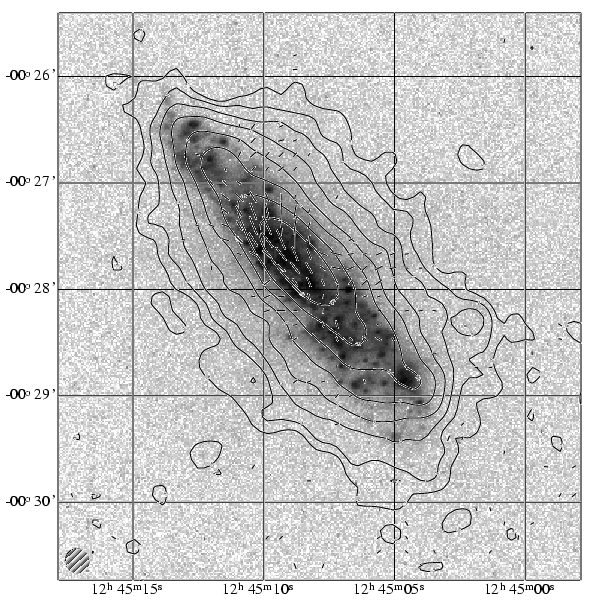
It is striking that the faint "whisps" in the underlying Hα image are visible exactly in regions were the little B-field vectors point out of the disk, and that the wisps follow the direction of the B-field indicated by the vectors. This is as close as one can get to proving that ionized gas moves along magnetic field lines.
Disclaimer:
Comments are always welcome. We give no guarantee
that the information presented on these pages is always correct or
up-to-date. External links are marked as such and we take no
responsibility for the contents of external pages.
All images on this site are protected by copyright & used by permission
of the respective owners. If you wish to reproduce them or any of the
material presented on this website, please contact us:
 We hereby acknowledge the original custodians of the land which is
described on these pages, including the Gomeroi/Gamilaraay people
of the North-west Slopes and Plains of NSW, and the traditional
owners of other lands and nations within this country. We acknowledge
elders past, present and emerging. Sovereignty was never ceded.
Last updated:
Wed, 18 February 2026, 9:01 +00:00