The "Day of the Fadeouts": 9 September 2005
Solar X-ray flares ionise parts of the Earth's ionosphere, leading to increased opacity to radio waves. As a consequence, when a Solar X-ray flare hits, one will observe a depression of incoming radio emission. Often this effect is overdubbed by simultaneous Solar radio continuum emission, but in some cases there is no such continuum radiation for a while. One can then see how the emission from the background sky (which determines the "normal" level of intensity) is attenuated, creating characteristic "dips" in the total power output of both channels of a SIMPLE interferometer. On 9 September 2005 there were several "X-class" (strong) Solar X-ray flares without associated Solar radio continuum emission, leading to several fadeouts. The first figure below shows 24 hours' worth of data, the second one zooms in to the time range when the fadeouts occurred.
The first fadeout started around 7:00 local time. Near its end the Sun started producing radio continuum emission (the squiggly part of the plot, with excess emission). Note that the interferometer obtained fringes on the Solar continuum, which can be seen in the lower panel.
Later in the day there is a whole group of 4 fadeouts that started around 02:45 UT (12:45 local time), followed shortly by another one and more fadeouts later in the day (not shown here).
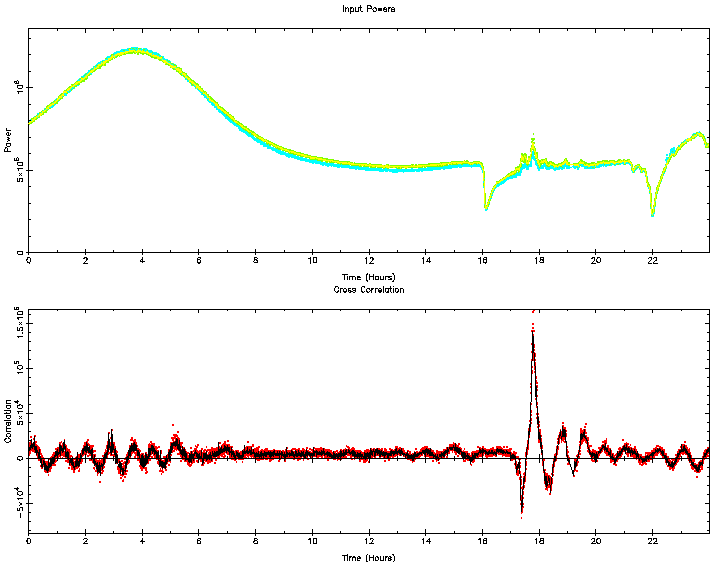
24 hr of SIMPLE observations (courtesy of David Brodrick), from about 8 September 2005, 5:00 UT, to 9 September 2005, 5:00 UT (click on image for larger postscript version of plot).
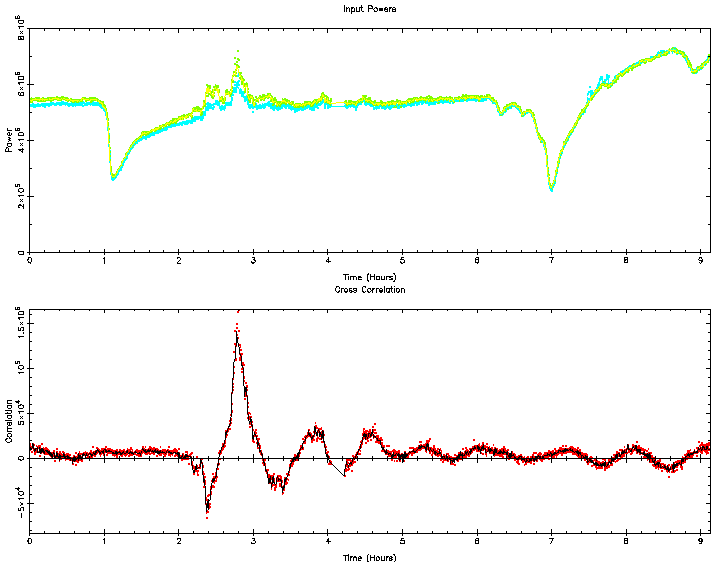
Zooming in to the time range of the multiple fadeouts. Note that at the end of the plotted time span (of 9 hours) the last fadeout was still ongoing (click on image for larger postscript version of plot).
All results presented on this page were obtained by the SIMPLE telescope operated by David Brodrick.
Disclaimer:
Comments are always welcome. We give no guarantee
that the information presented on these pages is always correct or
up-to-date. External links are marked as such and we take no
responsibility for the contents of external pages.
All images on this site are protected by copyright & used by permission
of the respective owners. If you wish to reproduce them or any of the
material presented on this website, please contact us:
 We hereby acknowledge the original custodians of the land which is
described on these pages, including the Gomeroi/Gamilaraay people
of the North-west Slopes and Plains of NSW, and the traditional
owners of other lands and nations within this country. We acknowledge
elders past, present and emerging. Sovereignty was never ceded.
Last updated:
Wed, 18 February 2026, 10:01 +00:00